The short answer
- An outlier post is a post whose result is far above what that same account usually gets.
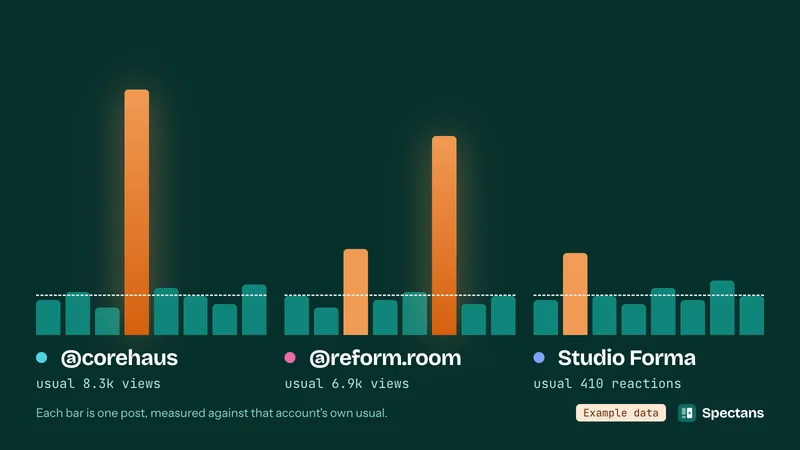
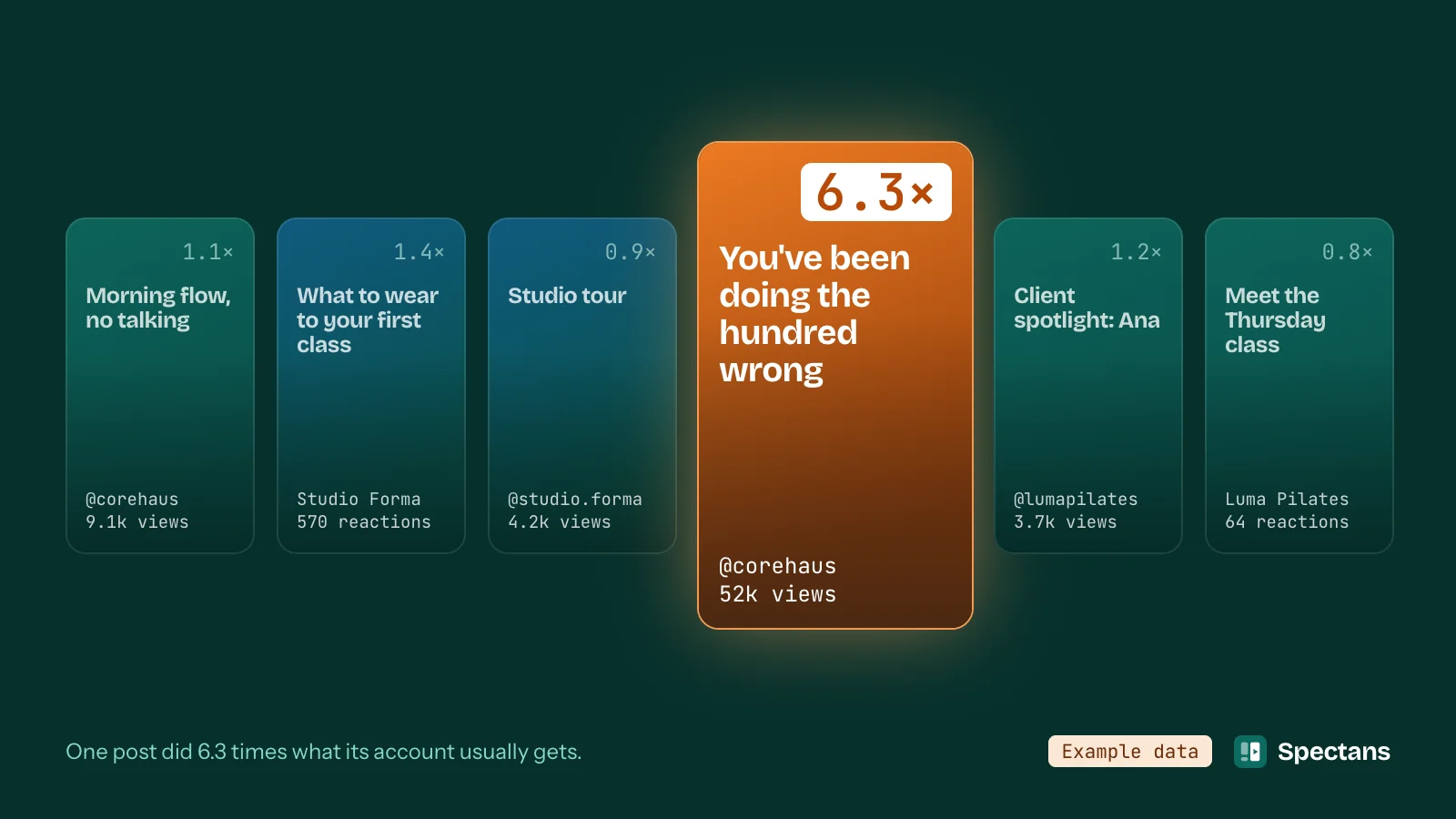
- You measure it with one division: the post’s result ÷ the account’s usual result. A post with 52k views on an account that usually gets 8.3k is a 6.3× outlier.
- Use the median of recent posts in the same format as the usual, and compare posts at the same age.
- Outliers are not the same as viral posts. A 7,400-view post can be an outlier; a 210,000-view post can be an ordinary day.
Read the transcript
Two posts. Which one worked? A post from an account with 1.2 million followers has 210 thousand views. A post from an account with 61 thousand followers has 52 thousand views. Compare each post with what its account usually gets: 240 thousand views for the first account and 8.3 thousand for the second. That number is the outlier multiple: 0.9× for the large account and 6.3× for the small one. Rank six posts by multiple instead of by views, and the posts worth learning from rise to the top. An outlier post is a post that beat its own account’s usual. Spectans calls 1.5× mild, 2× strong and 5× huge. The accounts and numbers in this video are example data.
An outlier post is a post that performed far above what the same account usually gets. You measure it as a multiple: the post’s result divided by the account’s usual result. A Reel with 52,000 views on an account whose Reels usually get 8,300 is a 6.3× outlier. The same 52,000 views on an account that usually gets 60,000 is an ordinary post.
Outlier post, defined
In statistics, an outlier is a value that sits far from the rest of its group. For social media the group is one account’s own recent posts. A post is an outlier when its result is well above the middle of that group.
Three parts make up the definition:
- The result. One number for the post, such as views on a TikTok video or likes plus comments on an Instagram carousel.
- The usual. What a normal post from that account gets in the same format. This is also called the baseline.
- The multiple. The result divided by the usual. This is the outlier multiple, written with a times sign: 2.4×, 6.3×.
The multiple is the useful part. It puts a 4,000-follower studio and a 1.2-million-follower chain on the same scale, because each is measured against itself.
Where the term comes from
“Outlier” in this sense spread from YouTube research tools, and most written definitions are still about YouTube. vidIQ’s help centre describes its outlier score as a video’s performance relative to the average of other videos on the same channel. TubeBuddy defines an outlier as a video that significantly outperforms the channel’s baseline average. The idea carries over to Instagram, TikTok and Facebook unchanged. What changes is the number you can measure, which we cover below.
The definitions in circulation disagree on three points, so check which one a tool or a guide is using:
| Point of disagreement | Versions you will meet | What we use, and why |
|---|---|---|
| The baseline | The channel’s average, or its median | The median. One viral post does not move it. |
| What a post is compared with | The account’s usual result, or its follower count | The usual result. “More views than followers” is a different test, and it misses outliers on large accounts. |
| The cut-off | Anything from 2× to 10× | 2× to study a post, 5× to call it huge. |
Why ranking by views misleads
Sort any list of posts by views and the biggest accounts come first. That tells you who has the largest audience. It does not tell you which posts did something worth learning from.
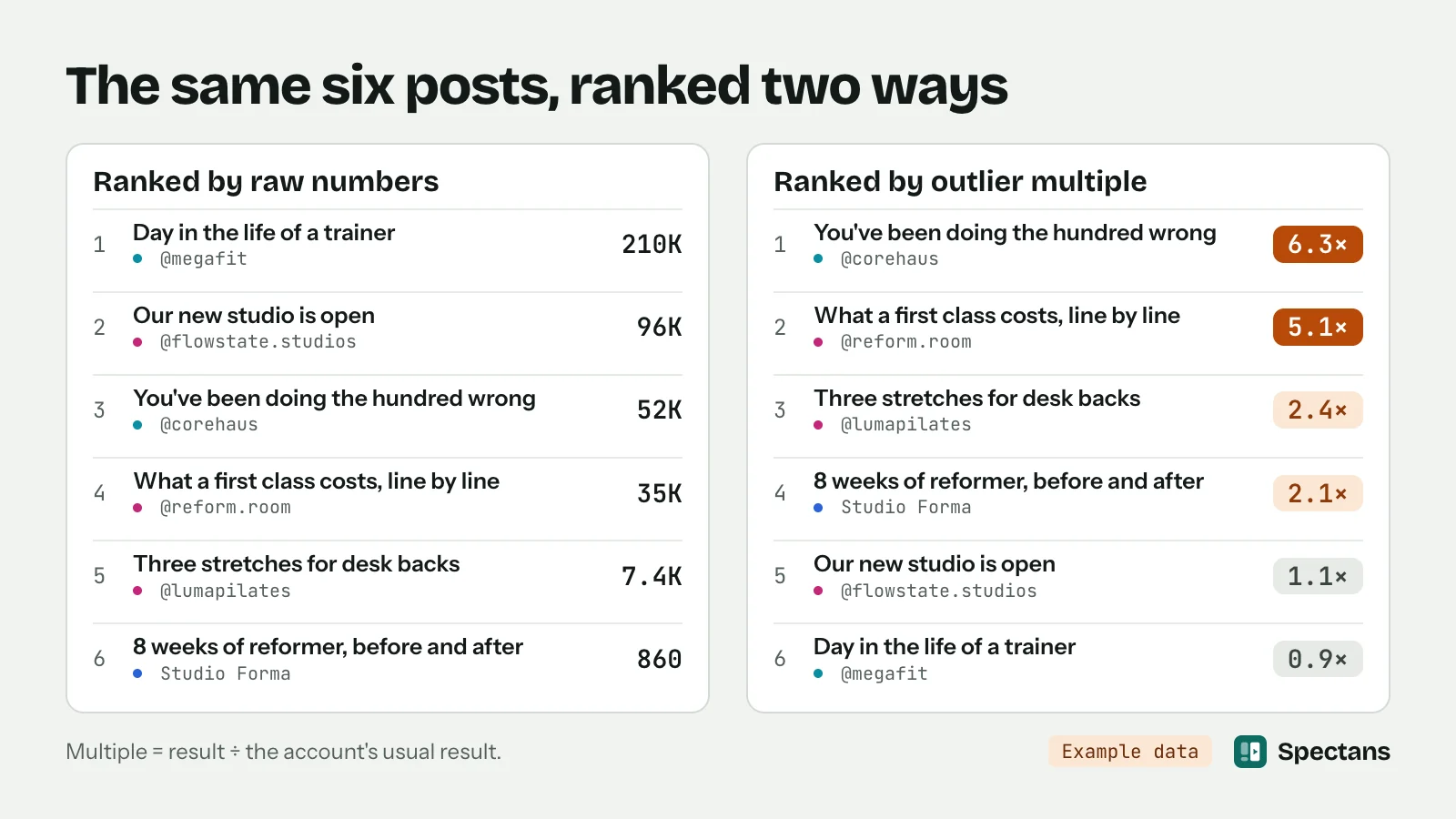
Here are six posts from one week in a pilates niche. The data is invented for the example.
| Post | Account | Result | Account’s usual | Multiple |
|---|---|---|---|---|
| Day in the life of a trainer | 1.2M followers | 210,000 views | 240,000 | 0.9× |
| Our new studio is open | 480,000 followers | 96,000 views | 88,000 | 1.1× |
| You’ve been doing the hundred wrong | 61,000 followers | 52,000 views | 8,300 | 6.3× |
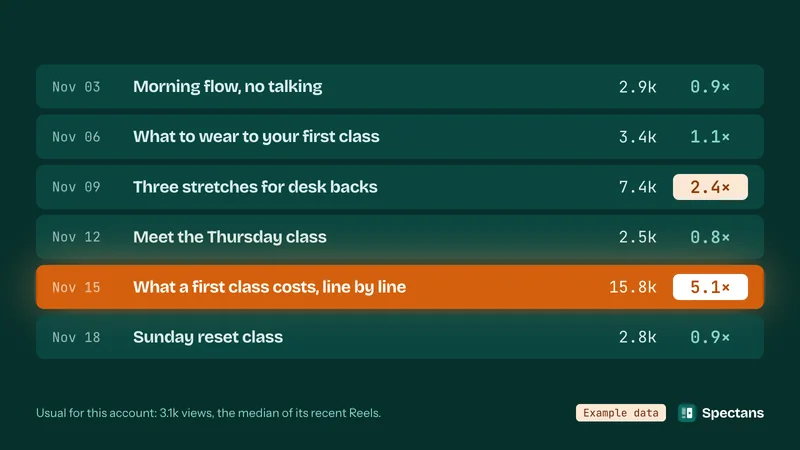
| What a first class costs, line by line | 25,000 followers | 35,000 views | 6,900 | 5.1× |
| Three stretches for desk backs | 8,400 followers | 7,400 views | 3,100 | 2.4× |
| 8 weeks of reformer, before and after | 12,000 followers | 860 reactions | 410 | 2.1× |
Ranked by views, the top two posts are two large accounts having a normal day. Ranked by multiple, they drop to the bottom, and the four posts that beat their own account’s usual rise.
The networks point the same way. TikTok said in 2020 that follower count is not a direct factor in its For You recommendations. Instagram’s own insights compare a Reel with the account’s past Reels, not with other accounts, as TechCrunch reported in January 2025. And on the help pages we read for this post, neither Instagram, TikTok nor Facebook publishes an average view count to compare against. An account’s own history is the only baseline you can actually get.
How the outlier multiple is calculated
The formula is one division:
Outlier multiple = the post’s result ÷ the account’s usual result
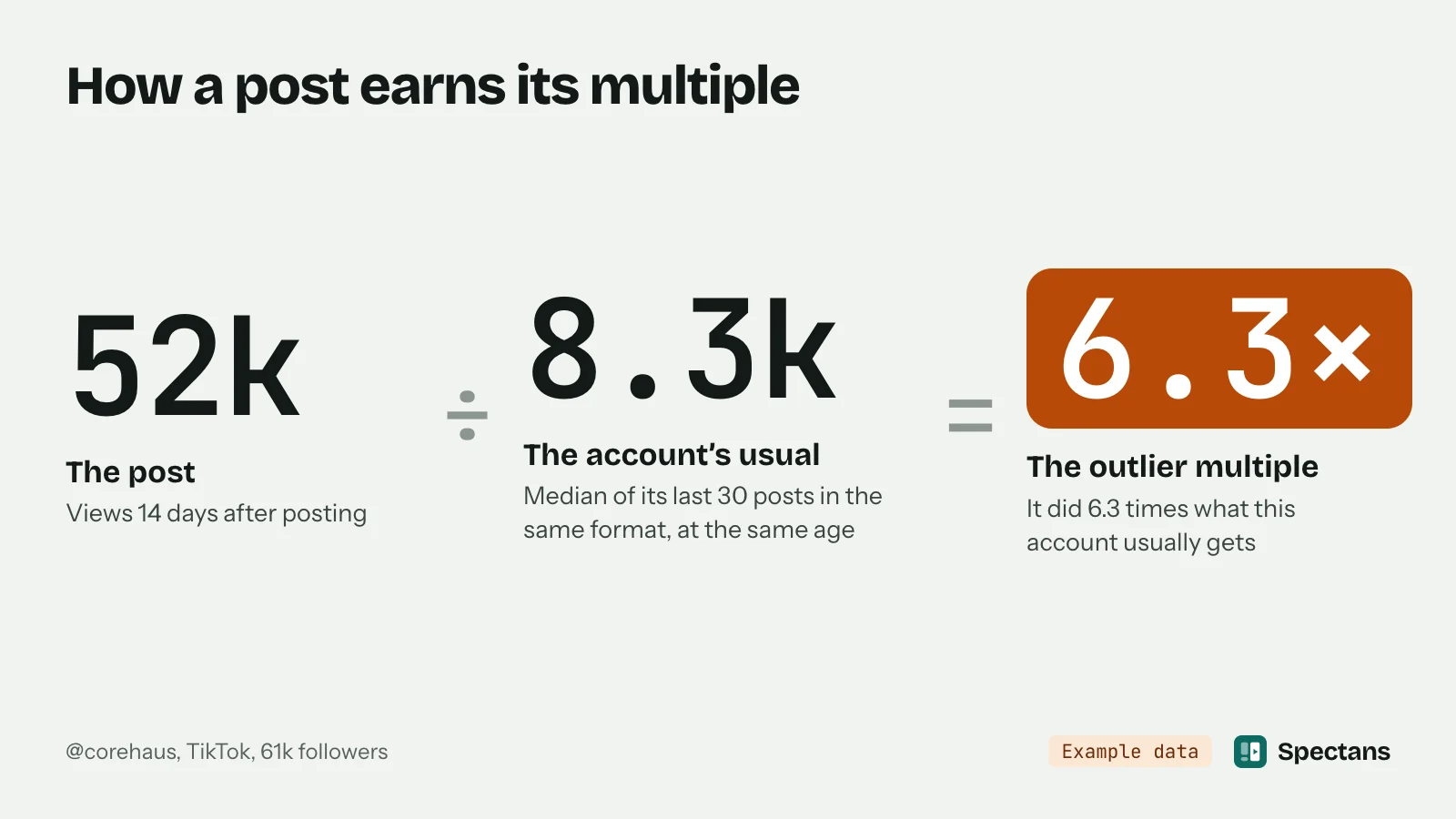
The division is simple. The three choices behind it decide whether the answer means anything.
1. Which number is the result
Use a number that any visitor can see, so you can measure competitors the same way as your own account. This is what Spectans compares:
| Network and format | Result that is compared |
|---|---|
| TikTok videos | Views |
| Instagram Reels and other video | Views |
| Instagram photos and carousels | Likes plus comments |
| Facebook posts of any format | Reactions plus comments |
A view is not the same event on every network. Instagram counts a Reel view when the Reel starts to play or replays, for example. That is one more reason to compare an account only with itself. We go through each network in what counts as a view.
2. What “usual” means
The usual should be a median, not an average. One huge post drags an average up and keeps it up, so the next good post looks ordinary. The median is the middle value, and one spike does not move it.
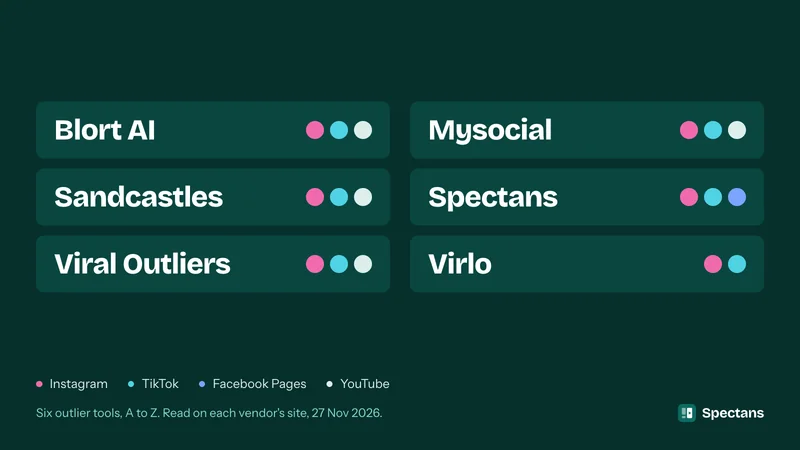
Spectans uses the median of the account’s last 30 posts in the same format, taken from the last 365 days, and waits until an account has 10 posts in that format before it scores anything. Other tools make different choices. These are the definitions we found on each vendor’s own site on 27 November 2026:
| Tool | How it defines the usual |
|---|---|
| Spectans | Median of the last 30 posts in the same format, at the same age |
| Sandcastles | Median views of the channel’s videos in the 90 days before the video |
| Mysocial | Median of the creator’s posts in the 90 days before each post |
| Rival IQ | Average engagement rate across the whole set of tracked companies, not the account’s own usual |
A score from one tool is not comparable with a score from another. A 3× in a tool that uses a 90-day median of all videos is a different claim from a 3× against the last 30 posts in one format.
3. When you read the number
Views keep growing for days after a post goes up. If you compare a two-day-old post with posts that have had months to collect views, it will look weak when it may be ahead of schedule. Compare each post with the usual at the same age. Spectans reads every post again at 1, 2, 3, 7 and 14 days for this reason. The step-by-step guide shows how to do it by hand.
How big does the multiple need to be?
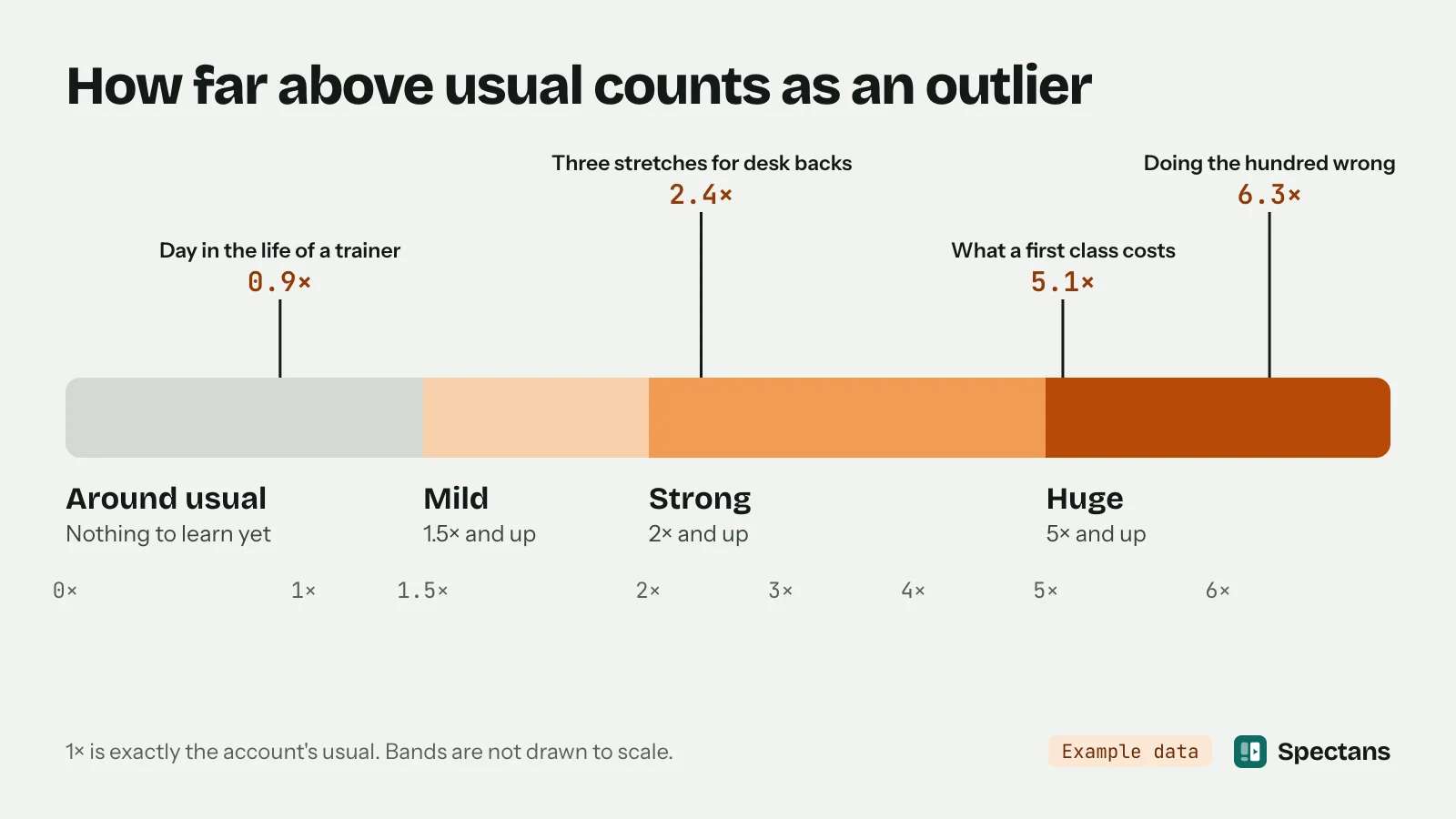
No network or standards body defines a cut-off. You choose one and keep it fixed. These are the thresholds Spectans uses:
| Multiple | What Spectans calls it | What it usually means |
|---|---|---|
| Below 1.5× | Around usual | Normal variation. Nothing to learn yet. |
| 1.5× to 2× | Mild | Worth a look if the same idea shows up twice. |
| 2× to 5× | Strong | Something in this post worked. Read it closely. |
| 5× and above | Huge | Rare. Check what else was going on that week. |
Outlier post vs viral post
“Viral” describes an absolute number. “Outlier” describes a number relative to the account.
| Viral post | Outlier post | |
|---|---|---|
| Measured against | Everyone | The account’s own usual |
| Typical size | Hundreds of thousands of views or more | Any size |
| Favours | Large accounts | No one |
| Useful for | Spotting trends | Learning what worked for an audience like yours |
A viral post from an account 100 times your size tells you little you can copy. A 4× outlier from a competitor your own size, in your own niche, is a direct lead.
What an outlier tells you, and what it does not
An outlier tells you that something about this post worked better than usual for this audience. It does not tell you what. The cause could be the topic, the first three seconds, the format, the timing or luck.
One outlier is an anecdote. The same idea beating the usual on three different accounts is a pattern, and patterns are what you plan content from.
How to use outlier posts
- Pick the accounts. Your own, and five to ten competitors that sell to the same people.
- Work out each account’s usual, by format.
- Score recent posts and keep the ones at 2× or more.
- Work out why each one worked: the hook, the structure, the questions in the comments.
- Turn the patterns into ideas for your own brand, and score your own posts the same way once they are live.
The full method, with a spreadsheet template and a calculator, is in how to find outlier posts on Instagram, TikTok and Facebook.
Questions
-
What is an outlier post?
An outlier post is a social media post that performed far above what the same account usually gets. It is measured as a multiple, the post’s result divided by the account’s usual result, so a 3× outlier got three times that account’s normal views or engagement.
-
Is an outlier post the same as a viral post?
No. Viral describes a large absolute number. Outlier describes a large number relative to the account that posted it. A small account’s post with 7,400 views can be a 2.4× outlier, and a large account’s post with 210,000 views can be below its usual.
-
What multiple counts as an outlier?
There is no official cut-off. Spectans calls 1.5× mild, 2× strong and 5× huge. Some other tools start at 3× the median. Pick a threshold, write it down and keep it the same across accounts so results stay comparable.
-
Should the usual be an average or a median?
A median. One very large post pulls an average up for weeks, which hides the next good post. The median is the middle value of the account’s recent posts, so a single spike does not move it.
-
How many posts does an account need before you can find its outliers?
Enough for a stable middle value. Spectans waits for 10 posts in a format and uses the last 30 from the past 365 days. With fewer than 10 posts, one unusual result changes the usual too much to trust the multiple.
-
Do outlier posts work for Instagram photos and Facebook posts, or only for video?
They work for any format, as long as you compare like with like. Spectans compares views for TikTok videos and Instagram video, likes plus comments for other Instagram posts, and reactions plus comments for Facebook posts.
Sources
We last read these pages on November 27, 2026.
- About Instagram insights Instagram Help Center
- Instagram gives creators more insight into their Reels performance TechCrunch, 29 January 2025
- How TikTok recommends videos TikTok Newsroom, 18 June 2020
- Outliers vidIQ Help Center
- Outlier YouTube videos and how to find them TubeBuddy
- Glossary Sandcastles Help Center
- Outliers Mysocial
- What’s a breakout post? Rival IQ Help Center
In Spectans
- Outlier detection
Every tracked post ranked by how far it beat its own account’s usual, not by raw views.
- Competitor tracking
Track your own accounts and your competitors’ on Instagram, TikTok and Facebook from a profile link.