The short answer
- A hook is what a viewer hears, reads and sees in the first seconds of a video. Meta defines it as the text, visual and audio that grab and hold attention in the first few seconds.
- The networks do not agree on one number. TikTok’s ad guidance says 6 seconds for the hook and 3 for the offer, Instagram says 3 seconds, and Meta and YouTube say the first few seconds.
- No network publishes a target for a good hook. Instagram measures skips in the first 3 seconds and gives no benchmark for it.
- Hook lists give you vocabulary. To find what works in your niche, tag the hook on each competitor post and compare outlier multiples by hook type.
A video hook is what a viewer hears, reads and sees in the first seconds of a video, before they decide to stay or scroll. A good one makes a clear promise fast, in words and in the picture at the same time. The lists of “viral hooks” online tell you what a hook can look like. Only your own niche’s data tells you which ones work.
What a video hook is
Meta gives the clearest definition from a network. In a December 2025 guide for Reels, it describes a hook as the text, visual and audio parts of a video that grab and hold attention in its first few seconds. TikTok treats the hook as the first of three parts of an ad, followed by a body and a close.
Two points follow from those definitions:
- A hook is not only a sentence. It is the sentence, the caption and the image together. A strong line over a dull picture is half a hook.
- A hook is the start of a structure, not a trick. It makes a promise that the rest of the video has to keep.
What the networks say about the first seconds
Advice online usually says “you have three seconds”. The companies themselves are less tidy.
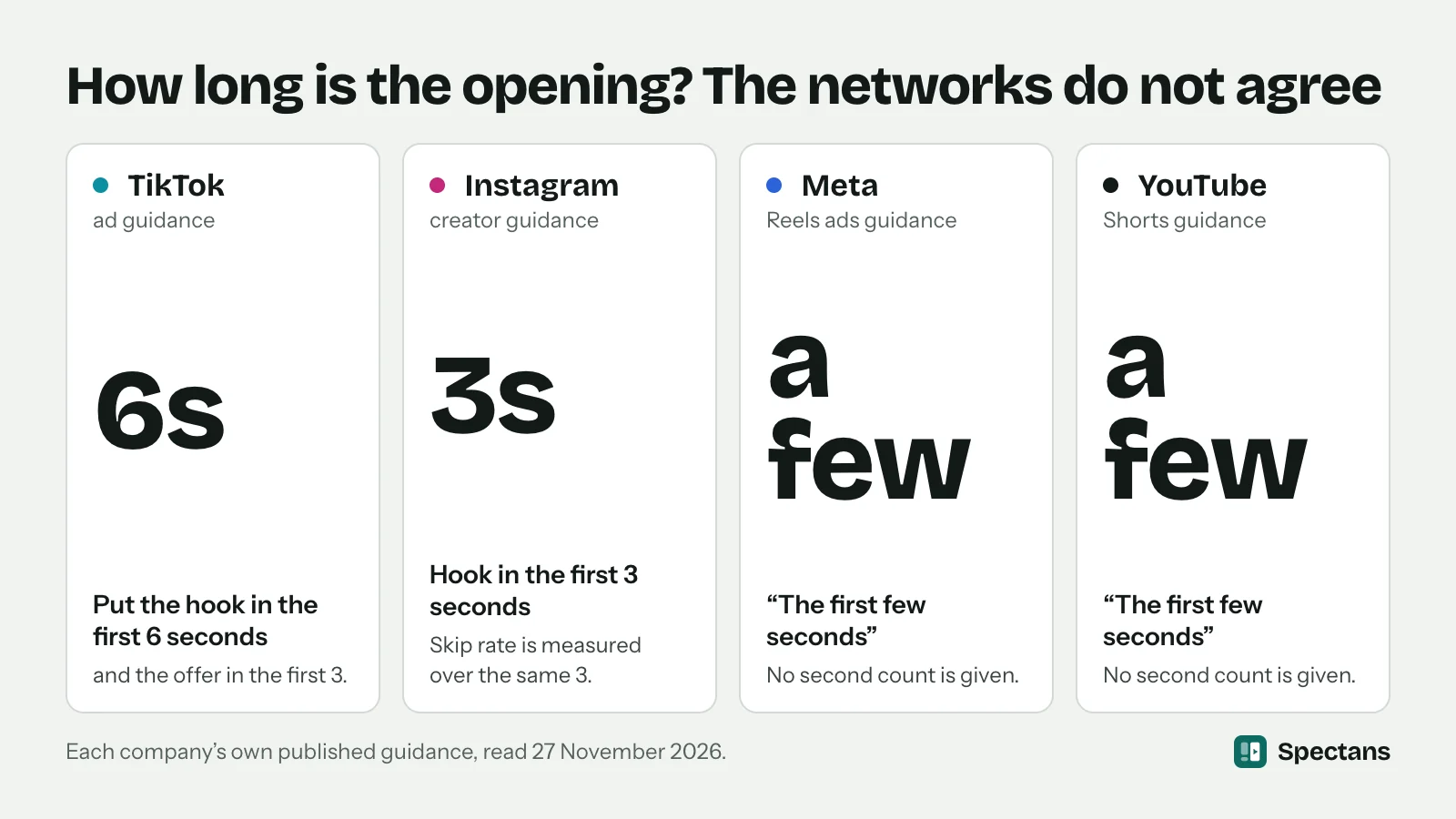
| Who | What their own guidance says |
|---|---|
| TikTok, ad guidance | Put the hook in the first 6 seconds, and introduce what you offer in the first 3. (source) |
| Instagram, for creators | Start with a hook in the first 3 seconds. (source) |
| Meta, for Reels ads | Get the hook right within the first few seconds. No second count. (source) |
| YouTube, for Shorts | Capture attention in the first few seconds. No second count. (source) |
Three seconds also shows up in what the networks measure:
- Instagram reports a skip rate for Reels: the share of views where people skipped within the first 3 seconds. It replaced an earlier “view rate” for the same 3 seconds, as Social Media Today reported in August 2025.
- Facebook keeps a 3-second video view, a play of at least 3 seconds, next to its main Views number.
None of them publishes a target. We found no Instagram, Facebook or TikTok page that says what a good skip rate or 3-second rate is. Figures such as “hold 60% past three seconds” come from tool vendors and agencies.
Why the opening matters to ranking
The opening matters because of what comes after it. Instagram’s head, Adam Mosseri, said in January 2025 that the three signals that matter most for ranking are watch time, likes and sends. TikTok says interactions, which may include time spent watching, are generally weighted more heavily than other factors. A hook earns nothing by itself. It buys the chance for the rest of the video to be watched.
The three layers of a hook
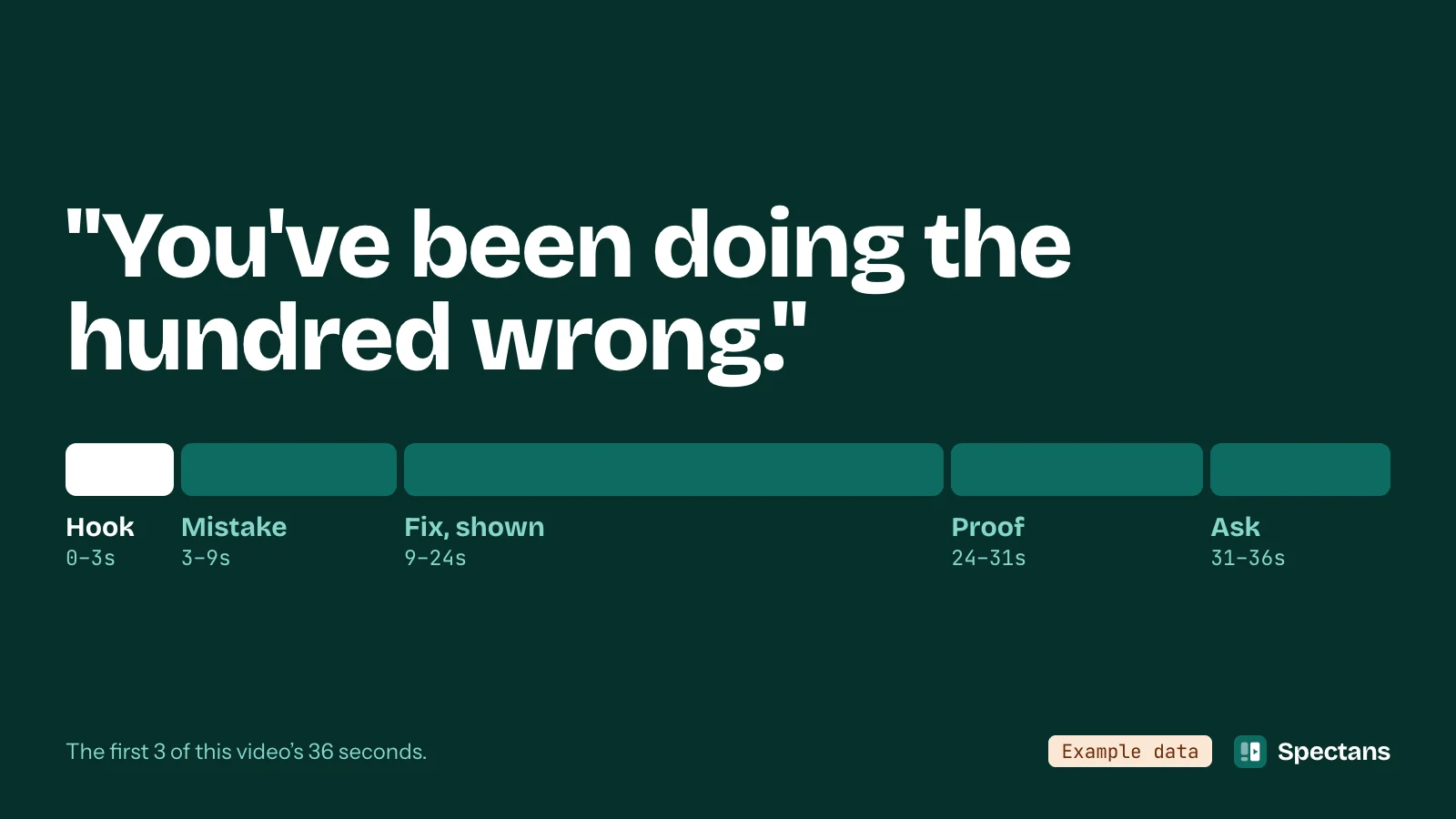
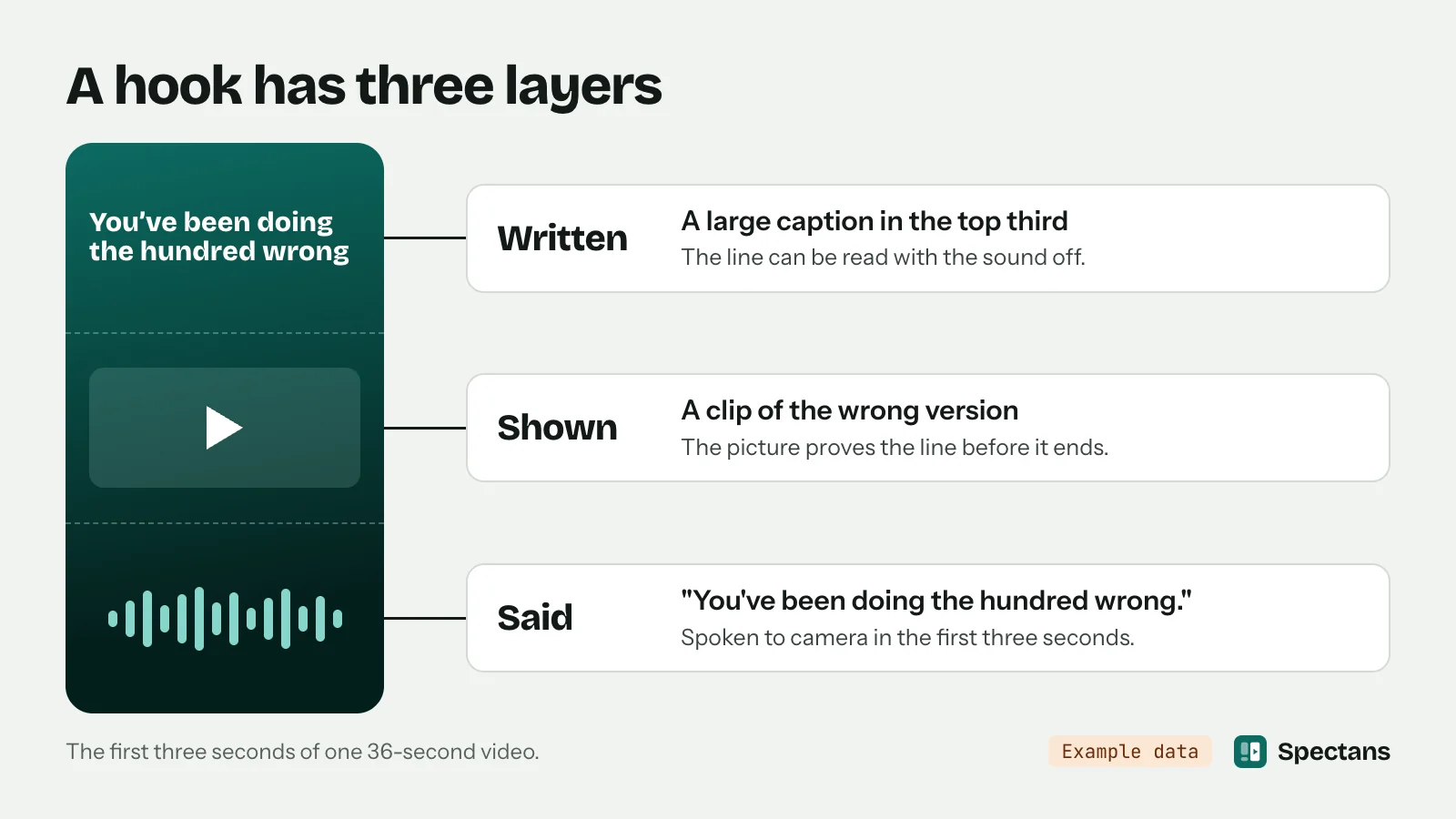
Take one video apart and the hook has three layers that land together.
| Layer | What it is | In the example |
|---|---|---|
| Said | The first spoken line | “You’ve been doing the hundred wrong.” |
| Written | Text on screen in the opening frames | The same line as a large caption in the top third |
| Shown | What the picture is doing while the line lands | A clip of the wrong version of the exercise |
When you study a competitor’s video, write down all three. Two posts with the same spoken line can perform very differently because one opens on a face and the other on the result.
Hook types, with example lines
Meta’s guide names three types of text hook: the value promise, the statement of intent, and the question or invitation. The table starts with those and adds four patterns we see often in short videos. The example lines are ours, written for an invented pilates studio.
| Type | What it does | Example line (ours) |
|---|---|---|
| Value promise (Meta) | States what the viewer gains | “Three stretches that undo a day at a desk.” |
| Statement of intent (Meta) | Says exactly what the video will show | “Here is what a first reformer class looks like.” |
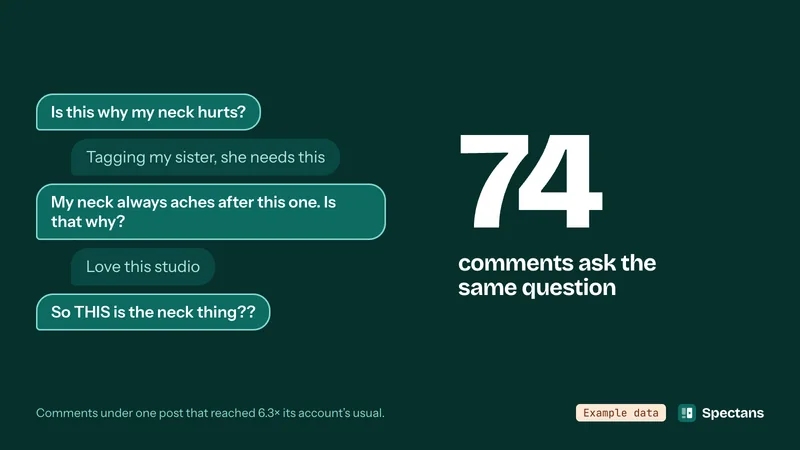
| Question or invitation (Meta) | Asks the viewer about their own experience | “Does your neck hurt in a roll-up?” |
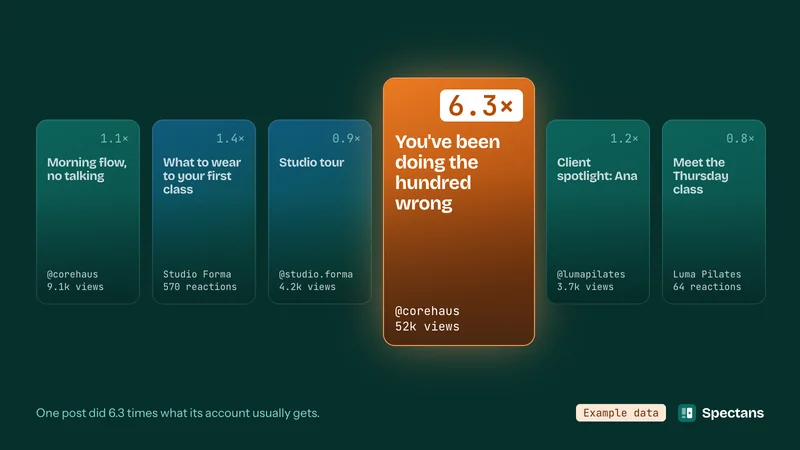
| Correction | Names a common mistake | “You’ve been doing the hundred wrong.” |
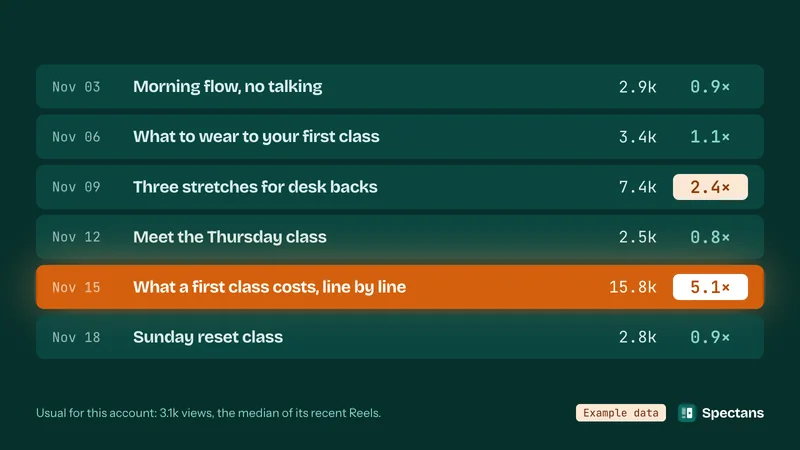
| Price or number | Opens with a figure people want to know | “What a first class costs, line by line.” |
| Result first | Shows the end before the process | “Eight weeks of reformer, before and after.” |
| Against common belief | Disagrees with something the audience assumes | “Pilates is not a cardio workout. Here is what it is.” |
Longer lists circulate, with 18 or 50 or 100 hooks. The ones we looked at came from creator-tool and agency blogs with no study or network source behind them. Treat any list, including this one, as names for what you observe. It does not tell you which type wins.
How to find the hooks that work in your niche
A hook type that works for finance creators may do nothing for a pilates studio. The way to find out is to check hooks against results, account by account.
- Collect recent posts from your own account and five to ten competitors.
- Score each post against its own account’s usual. This gives every post an outlier multiple, so a small account’s good post counts as much as a large one’s. The method is in how to find outlier posts.
- Write down the hook of every post, ordinary ones included: the three layers and the type. If you tag only the winners, every type looks like a winner.
- Compare by type. Count how many posts of each type reached 2× or more.
- Write your own version with the type that keeps winning, on a topic that is yours. Score it after it is posted.
A filled-in comparison looks like this. The numbers are invented for the example.
| Hook type | Posts | Posts at 2× or more | Median multiple |
|---|---|---|---|
| Correction | 9 | 5 | 2.3× |
| Price or number | 6 | 3 | 1.9× |
| Value promise | 14 | 3 | 1.2× |
| Statement of intent | 11 | 1 | 0.9× |
In this made-up niche, corrections beat their accounts’ usual more than half the time, and plain statements of intent almost never do. That is something you can act on, and no hook list could have told you.
Two cautions. Small counts mislead, so wait for a type to show up on several accounts before you trust it. And the hook is one cause among several: the topic, the length and the comments a post draws all move its result.
Common mistakes
- A promise the video does not keep. Viewers leave a few seconds after the hook, and watch time is what the networks say they weigh.
- A slow start. A greeting, a logo sting or “so today I wanted to talk about” spends the seconds every network’s guidance tells you to use.
- Text nobody can read. Small captions, captions under the app’s own buttons, or a line that needs more than a glance.
- Copying the line without the layers. The spoken words are the easiest part to copy and often the least important.
- Assuming branding first is free. Google’s 2015 study of skippable YouTube ads found that showing the brand in the first five seconds raised recall but also made people more likely to skip. It studied ads, not Shorts or Reels, but the trade-off is worth remembering.
Where to go next
Once you know which hook types win in your niche, the next step is the rest of the script: what the video has to deliver after the opening. For the wider method of studying competitors, see social media competitor analysis.
Questions
-
What is a hook in a video?
A hook is the opening of a video, the part that decides whether a viewer keeps watching or scrolls on. It has three layers that work together, which are the first spoken line, the text on screen and what the picture shows. Meta describes it as the text, visual and audio components that grab and hold attention in the first few seconds.
-
How long should a video hook be?
There is no single official length. TikTok's ad guidance says to put the hook in the first 6 seconds and the offer in the first 3. Instagram's creator guidance says the first 3 seconds. Meta and YouTube say the first few seconds without a number. Planning for 3 seconds satisfies all of them.
-
What is a good hook rate or 3-second view rate?
No network publishes one. Instagram reports a skip rate, the share of views where people skipped within the first 3 seconds of a Reel, but gives no target value. Benchmarks such as "above 60%" come from tool vendors and agencies. Compare a video with your own account's usual instead.
-
What are the main types of video hooks?
Meta names three types of text hook, which are the value promise, the statement of intent and the question or invitation. Other patterns creators use include correcting a common mistake, revealing a price or number, showing the result first and making a claim against common belief. Longer lists exist but we found no study behind them.
-
Do hooks matter more than the rest of the video?
The hook decides whether the rest gets watched, but the networks reward watching, not opening. Instagram's head named watch time, likes and sends as the top three ranking signals in January 2025. A strong hook on a video that does not deliver loses viewers a few seconds later.
-
How do I know which hooks work in my niche?
Collect recent posts from your own account and your competitors, score each against its account's usual result, and write down the hook type of each one. Hook types that keep appearing among posts at 2 times usual or more, across several accounts, are the ones worth testing.
Sources
We last read these pages on November 27, 2026.
- The science of the hook: how to supercharge your Reels performance Meta for Business, 15 December 2025
- Creative best practices for performance ads TikTok Business Help Center, updated June 2025
- Creative best practices from top-performing ads TikTok for Business blog
- Helping creators of all sizes break through Instagram for Creators, 26 February 2025
- Your guide to getting started with YouTube Shorts YouTube Official Blog, 8 April 2025
- Instagram media insights reference (reels_skip_rate) Meta for Developers
- Instagram adds retention insights for Reels Social Media Today, 24 August 2025
- Video insights reference (3-second video views) Meta for Developers
- Post on the top ranking signals Adam Mosseri, Head of Instagram, 21 January 2025
- How TikTok recommends content TikTok Support
- Updated features for video ads Meta for Business
- The first 5 seconds: creating YouTube ads that break through in a skippable world Think with Google, June 2015
In Spectans
- Hook and video analysis
Each outlier taken apart: the hook, the structure, the transcript and what is on screen.
- Scripts and captions
A timed script with shots and on-screen text, and a caption per network, for every approved idea.